

Smart Kid General Knowledge Olympiad 
“Liberty cannot be preserved without General Knowledge among the people”
- John Adams


Edition
17th
Class 1 to 10
About SKGKO
Smart Kid General Knowledge Olympiad (SKGKO)
The SilverZone Foundation's Smart Kid General Knowledge Olympiad (SKGKO) offers students an outstanding platform to showcase their knowledge. It covers key areas like History, Geography, General Science, Current Affairs, and Sports. Held annually at national and international levels, SKGKO provides a global stage for young minds to shine.
Key Features and Benefits for Students:
- Open to students in Classes 1 to 10 from CBSE, ICSE, ICBSE, or any recognised state board in India.
- Questions challenge students to think creatively, sharpening skills for competitive exams and beyond.
- Enhances cognitive and problem-solving abilities.
- Boosts academic performance across subjects.
- Encourages a lifelong thirst for knowledge.
Sections
The question paper is class-specific and usually consists of the following sections:
- 1
(For Classes I –V)
(i) Section-1: General Awareness
(ii) Section-2: Scholar’s Zone
- 2
(For Classes VI –X)
(i) Section-1: General Awareness
(ii) Section-2: Current Affairs
(iii) Section-3: Scholar’s Zone
Key Features of the Exam Structure
- Each class will receive a separate and class-specific question paper to ensure appropriate difficulty levels.
- All questions are objective-type (Multiple Choice Questions).
- There is no negative marking, encouraging students to attempt all questions confidently.
- The Smart Kid General Knowledge Olympiad is conducted only in English to maintain a standardised assessment format and ensure clarity in technical terminology used across all classes.
The Olympiad is held once a year and is conducted during school hours to ensure student convenience and maximum participation. Each participating school can select one of the three proposed dates for conducting the Olympiad. All dates will have separate sets of question papers, ensuring exam integrity and flexibility in scheduling.
Test Paper Structure:
The language medium is English only. The examination is being conducted for all classes from 1st to 10th with the following details:
The details of the manner in which the test is to be conducted will be sent with the question papers. For classes 1st onward, OMR answer sheets will be provided.
Important Note For Schools:
Registration Of Students:
The Smart Kid General Knowledge Olympiad (SKGKO) prospectus, along with registration forms, is sent to all schools currently registered with the SilverZone Foundation. Please note that the printed prospectus may not reflect the most recent updates. The latest information on syllabus, exam format, levels, and prizes is always available on our official website. We recommend referring to it for accuracy.
For New Schools:
Schools not yet registered with SilverZone may request a prospectus by writing to us at info@silverzone.org. Once received, schools must return the completed registration forms by the specified deadline.
About
Smart Kid General Knowledge Olympiad (SKGKO)
The SilverZone Foundation's Smart Kid General Knowledge Olympiad (SKGKO) offers students an outstanding platform to showcase their knowledge. It covers key areas like History, Geography, General Science, Current Affairs, and Sports. Held annually at national and international levels, SKGKO provides a global stage for young minds to shine.
Key Features and Benefits for Students:
- Open to students in Classes 1 to 10 from CBSE, ICSE, ICBSE, or any recognised state board in India.
- Questions challenge students to think creatively, sharpening skills for competitive exams and beyond.
- Enhances cognitive and problem-solving abilities.
- Boosts academic performance across subjects.
- Encourages a lifelong thirst for knowledge.
Overall, the Smart Kid General Knowledge Olympiad is an excellent platform for students to showcase their knowledge and learning in various disciplines. It encourages them to develop a thirst for knowledge and an enthusiasm for learning that can help them in their future academic and personal pursuits.
Sections
The question paper is class-specific and usually consists of the following sections:
(For Classes I –V)
- (i) Section-1: General Awareness
- (ii) Section-2: Scholar’s Zone
(For Classes VI –X)
- (i) Section-1: General Awareness
- (ii) Section-2: Current Affairs
- (iii) Section-3: Scholar’s Zone
Key Features of the Exam Structure
- Each class will receive a separate and class-specific question paper to ensure appropriate difficulty levels.
- All questions are objective-type (Multiple Choice Questions).
- There is no negative marking, encouraging students to attempt all questions confidently.
- The Smart Kid General Knowledge Olympiad is conducted only in English to maintain a standardised assessment format and ensure clarity in technical terminology used across all classes.
The Olympiad is held once a year and is conducted during school hours to ensure student convenience and maximum participation. Each participating school can select one of the three proposed dates for conducting the Olympiad. All dates will have separate sets of question papers, ensuring exam integrity and flexibility in scheduling.
Test Paper Structure:
The language medium is English only. The examination is being conducted for all classes from 1st to 10th with the following details:
- For Classes 1-2: There will be 25 questions, and the duration will be 40 Minutes
- For Classes 3-5: There will be 30 questions, and the duration will be 40 Minutes.
- For Classes 6-8: There will be 35 questions, and the duration will be 40 Minutes.
- For Classes 9-10: There will be 40 questions, and the duration will be 50 Minutes.
The details of the manner in which the test is to be conducted will be sent with the question papers. For classes 1st onward, OMR answer sheets will be provided.
Registration Of Students:
The Smart Kid General Knowledge Olympiad (SKGKO) prospectus, along with registration forms, is sent to all schools currently registered with the SilverZone Foundation. Please note that the printed prospectus may not reflect the most recent updates. The latest information on syllabus, exam format, levels, and prizes is always available on our official website. We recommend referring to it for accuracy.
For New Schools:
Schools not yet registered with SilverZone may request a prospectus by writing to us at info@silverzone.org. Once received, schools must return the completed registration forms by the specified deadline.
Important Note For Schools:
- Any school can become a registered centre for the Smart Kid General Knowledge (SKGKO). There is no fee required to register the school itself.
- For smooth coordination and exam feasibility, a minimum of 40 students per school is required to register for the General Knowledge Olympiad.
- For any clarification regarding exam rules, syllabus, paper pattern, or registration process, schools may write to us directly at info@silverzone.org
Quick Challenge
Five questions. Sixty seconds. No negative marking.
A warm-up in the Olympiad style: general knowledge questions with one correct answer each, answered against the clock.
- Just like the real paper, every question is multiple choice with no negative marking, so attempt them all.
- You get an explanation after each answer.
- Finished? Download the sample paper for your class and try the real format.
Ready for a warm-up?
Five short questions on currencies, history, national parks, books and abbreviations.
Original practice questions written for this page to show the objective format — not from an official SKGKO paper. The 60-second timer and scoring apply to this warm-up only.
Complete Syllabus
SKGKO syllabus for Class 1 to 10
Every class has its own General Knowledge Olympiad syllabus. Select a class to explore all topics and chapters in one clear view.
Topics and chapters
Class 1General Awareness
15 chapters- Important days
- Means of transport
- Means of communication
- Buildings and monuments
- Family and relation
- Our surroundings & helpers
- Places of worship
- Animals
- Vegetables
- Fruits
- Flowers
- Body parts and sense organs
- Food
- Religious
- National and family festivals
Identification
2 chapters- Personality
- Objects
Sports and Games
2 chapters- Indoor games & outdoor games
- Players associated with sports
Scholar’s Zone
1 chapter- Scholar’s Zone
The syllabus is arranged class-wise so students can quickly find the topics and chapters covered in their Smart Kid General Knowledge Olympiad paper.
How the SKGKO score is calculated
The raw score is computed by multiplying each correct answer by its corresponding base marks and summing the results.
Total marks are determined by adding the raw score to the sum of the weightage of correct answers. Each question carries an additional weightage, starting from .0001 and increasing incrementally (.0002, .0003, and so forth). Question 1 has a weightage of .0001, question 2 has .0002, and so on.
This weightage is utilised to resolve ties when calculating class, zonal and Olympiad ranks.
Try the tie-breaker
Tap questions to mark them correct and watch the weightage separate two equal raw scores.
Example General Knowledge paper: 10 questions at 3 marks each.
6 of 10 correct. Two students with 18 raw marks are separated by which questions they answered correctly.
Class rank
This encompasses all students from various sections and divisions of the same class within the same school.
Olympiad rank
This encompasses all students from India and abroad belonging to the same class.
One award per exam
Each winner is entitled to one award per exam, receiving the higher-level award only. For example, international top three rank holders will receive awards based on their international ranks, and any awards based on their zonal ranks will be passed to the next rank holder. Similarly, if a zonal award winner also qualifies for a class award, the class award will be given to the next rank holder.
Sample Papers
Sample Question Papers
The detailed Syllabus and Sample Test Paper are provided in this website, click the following links to download the Syllabus and Sample Test Paper class wise. For Books please contact, School Coordinator or book your order online now The syllabus is being modified for year 2025-26 as advised by the Boards. Please keep visiting our website for an updated syllabus.
Prizes, dates and venue
What you can win
Drag along the ranks and watch the award change.
Cash prizes of ₹10,000, ₹7,500 and ₹5,000 for the top three International Olympiad rank holders in every class; gift certificates of varying values for ranks 4 to 25; Topper Achievement Certificates up to rank 500; Medals of Excellence for Zonal, State and Class toppers; and a participation certificate for every student who sits the paper.
Where did you rank?
Drag the medal, tap a rank, or use the arrow keys. Every award shown here is the one published for that rank.
Also receives
- Participation certificate with all your ranks
- Medal of Excellence if you also top your class, zone or state
The 1st International Olympiad rank holder in each class receives a prize of ₹10,000/-.
Three more ways to win a medal
Hover or tap a card to read the rule.
One award per exam — each winner receives the higher-level award.
Every participant takes something home
All participants are awarded Participation Certificates reflecting their Class, Zonal, State and Olympiad ranks and their marks — so every student sees exactly where they stand.
Certificates reach students through their school along with the results.
What if students tie on the same rank?
Drag the slider to see how a shared rank is settled at the rank you picked above.
- Awarded in full, with the participation certificate.
The rules behind the awards
How ties and overlapping awards are settled.
The award amount is divided equally among the winners, and each recipient is honoured with a Symbolic Golden Medal of Excellence in the relevant category along with a certificate.
Instead of a shared award, each winner receives a gift certificate coupon, along with a Medal of Excellence in the relevant category and a Special Achievement Certificate.
Each winner receives the higher-level award only. Any award based on a Zonal rank passes to the next rank holder, and if a Zonal award winner also qualifies for a class award, the class award goes to the next rank holder.
At school level the top three rank holders in each class receive Medals of Excellence, provided the topper obtains at least 50% marks.
Zones
Zone and state categorisation
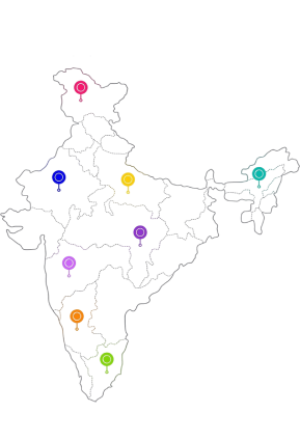
To streamline operations, all states and Union Territories in India, along with participating international countries, are organised into five zones.
North Zone
States and Union Territories in this zone.
- Delhi NCR
- Haryana
- Punjab
- Himachal Pradesh
- Uttarakhand
- J&K
- Ladakh
- Chandigarh
- Rajasthan
- Uttar Pradesh
This categorisation serves the following purpose: determining zone toppers for performance-based awards.
All zones at a glance (text version)
| Zone | States, Union Territories and countries |
|---|---|
| North Zone | Delhi NCR, Haryana, Punjab, Himachal Pradesh, Uttarakhand, J&K, Ladakh, Chandigarh, Rajasthan, Uttar Pradesh |
| East Zone | West Bengal, Bihar, Jharkhand, Odisha, Assam, Arunachal Pradesh, Tripura, Sikkim, Meghalaya, Mizoram, Nagaland, Manipur, Chhattisgarh |
| South Zone | Tamil Nadu, Karnataka, Kerala, Telangana, Puducherry, Lakshadweep, Andhra Pradesh, Andaman & Nicobar |
| West Zone | Maharashtra, Goa, Gujarat, Daman & Diu, Dadra & Nagar Haveli, Madhya Pradesh |
| International Zone | Australia, Bahrain, Canada, Ghana, Japan, Kuwait, Malaysia, Nepal, Oman, Qatar, Russian Federation, Saudi Arabia, Singapore, Thailand, United Arab Emirates (UAE), United Kingdom, United States of America (USA) |
Tap a bubble to try it — darken one bubble per question
Answer Sheet
Sample OMR answer sheet
Unlock the perfect answer sheet: click below for your free PDF download.
See exactly how the OMR sheet looks before exam day, so filling it in feels familiar. Try the bubbles on the sample sheet — then download the real one.
Sample answer sheet (PDF)- Positive reviews
- Professional instructors
- 2.1 million+ happy students
Study Material
Recommendation & Books
PREVIOUS YEAR PAPERS
COMPREHENSIVE BOOK
INSTANT DOWNLOAD PAPERS
FAQ
GK Olympiad FAQs
Quick answers about eligibility, exam pattern, sections, scoring, prizes and registration.
What is the Smart Kid General Knowledge Olympiad (SKGKO)?
SKGKO is SilverZone Foundation’s annual General Knowledge Olympiad for students of Classes 1 to 10. It covers areas such as history, geography, general science, current affairs and sports, and rewards curiosity about the world beyond the classroom.
Who can take part in SKGKO?
Students of Classes 1 to 10 from CBSE, ICSE, ICBSE or any recognised state board can take part through their school. Any school can become a registered SKGKO centre free of charge; a minimum of 40 students per school must register for the General Knowledge Olympiad.
What is the SKGKO exam pattern?
Each class sits its own objective (multiple-choice) paper in English, answered on an OMR sheet. Classes 1–2 answer 25 questions in 40 minutes, Classes 3–5 answer 30 questions in 40 minutes, Classes 6–8 answer 35 questions in 40 minutes and Classes 9–10 answer 40 questions in 50 minutes. There is no negative marking. The Olympiad is held once a year during school hours, and each school chooses one of three proposed dates.
Which sections does the GK Olympiad paper have?
Classes 1 to 5 answer General Awareness and a Scholar’s Zone. Classes 6 to 10 answer General Awareness, Current Affairs and a Scholar’s Zone. Each class has its own syllabus — for example, Class 7 covers history, polity, geography, general awareness and current affairs.
How are SKGKO scores and ranks worked out?
The raw score is the total of the base marks for every correct answer. A tiny weightage (.0001 for question 1, .0002 for question 2 and so on) is added for each correct answer and is used only to break ties. Every participant receives a certificate showing their class, zonal, state and Olympiad ranks along with their marks.
What prizes does the GK Olympiad offer?
In every class, the top three International Olympiad rank holders receive ₹10,000, ₹7,500 and ₹5,000. Ranks 4 to 25 receive gift certificates, ranks up to 500 receive Topper Achievement Certificates, and zonal, state and class toppers receive Medals of Excellence (class toppers must score at least 50%). Each winner receives one award per exam — the higher-level one.
How does a school register for SKGKO?
Registration is through schools. SilverZone sends the SKGKO prospectus and registration forms to every school registered with the Foundation. Schools not yet registered can request a prospectus by writing to info@silverzone.org and must return the completed forms by the stated deadline.
Where can I find SKGKO sample papers and books?
Class-wise syllabuses, sample question papers and a sample OMR answer sheet are available on the General Knowledge Olympiad page. Previous Year Papers, the Comprehensive Book and instant-download papers can be ordered online or through your school coordinator.